
Installed UK-wide
Roller shutters and grilles
Steel or aluminium shutters and grilles, manual or motorised, fitted across the UK. Solid external shutters are the single most common reason a shopfront application is refused, so we start from internal and open-lattice designs and only go solid where the setting allows it. Indicative prices run from £800–£1,500 for a manual shutter to £1,200–£2,500 motorised.
Consents this work tends to involve
- Planning permissionUsually needed
An external shutter, its box and guides change the look of the frontage. Internal shutters behind the glass often avoid this.
- Listed building consentSometimes
Any shutter on a listed building, including an internal one fixed to historic fabric.
- Building regulationsOccasionally
Mostly where a shutter closes off an escape route or forms part of a fire separation.
An installer’s general guide; your council decides.
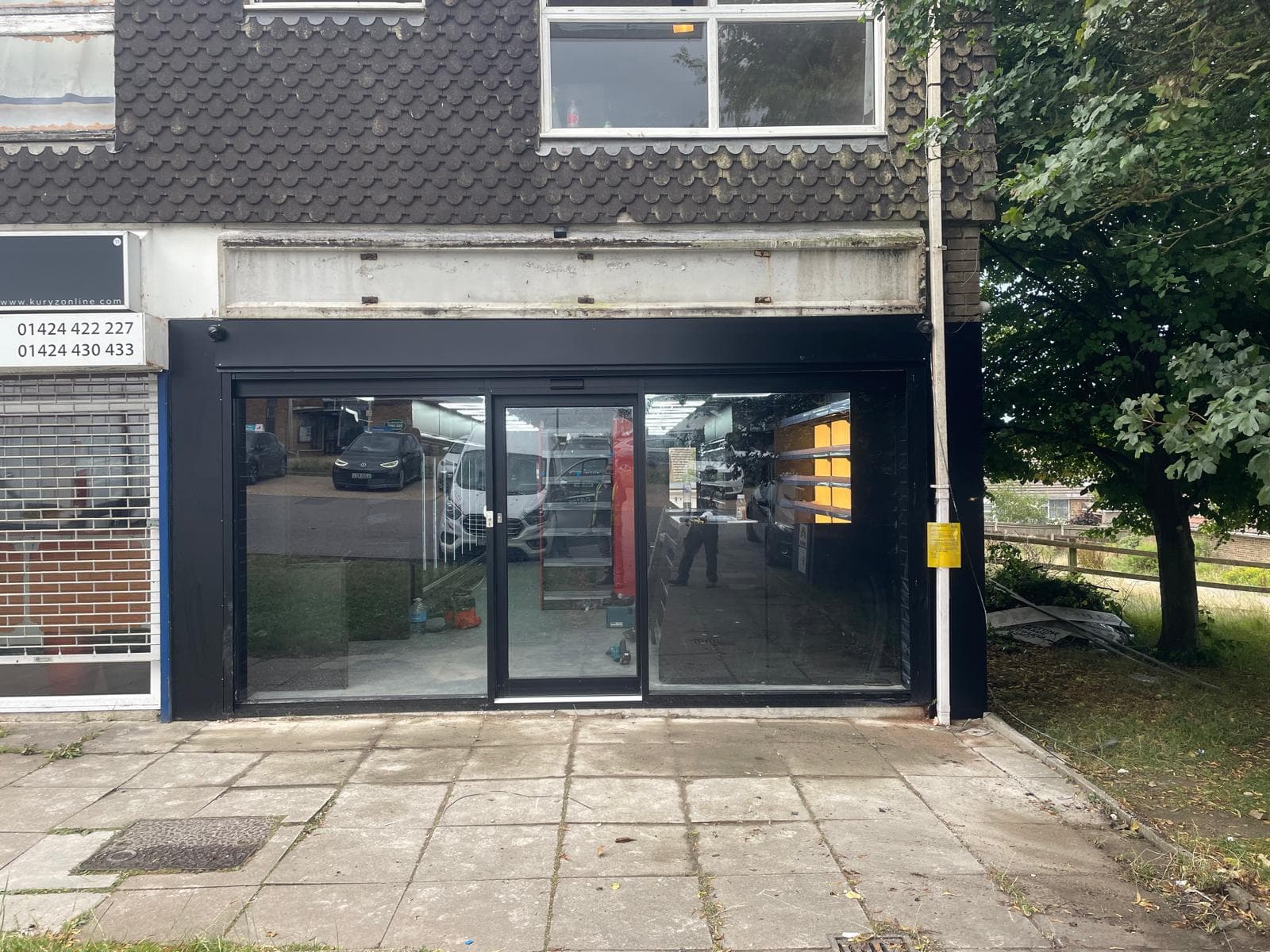
Why do solid shutters get refused?
A street of closed solid shutters is dead after six o’clock: nothing to look at, no light on the pavement and nowhere for anyone to see in. Councils link that to fear of crime and graffiti, and most of the shopfront guides we track either rule solid external shutters out in conservation areas or accept them only in narrow exceptions.
Perforated or “pinhole” shutters do not get you round this. Several councils say plainly that they look almost solid once they are down.
Which shutter types are easiest to get approved?
Roughly from easiest to hardest: an internal lattice grille behind the glass; a removable mesh grille; an external lattice or brick-bond grille; a punched or polycarbonate “vision” shutter; a perforated shutter; a solid one. Where the box goes matters as much as the curtain — behind the fascia, never hung on the face of the building.
Colour is the cheap win. A shutter powder-coated to match the shopfront reads as part of it; bare galvanised steel reads as an afterthought, and some councils name it as unacceptable.
Manual or motorised?
Manual spring-balanced shutters suit narrow openings used once a day. Wider or heavier curtains, or a shutter someone lifts several times a day, should be motorised. Powered shutters have to meet the safety-in-use standard for powered doors, which covers safety edges and safe stopping — not optional extras.
Standards and regulations
| Reference | What it covers |
|---|---|
| BS EN 13241 | Product standard for industrial, commercial and garage doors and gates, including shutters. |
| BS EN 12453 | Safety in use of power-operated doors: forces, safety edges and stopping. |
| LPS 1175 | Loss Prevention Standard for intruder-resistant products. Older grades run SR1–SR8; Issue 8 uses ratings such as B3 or C5, where the letter is the tool category and the number the minutes of resistance. |
| BS EN 16034 | Fire-resistance characteristics, used with BS EN 13241 for fire shutters. |
Indicative prices
- Manual shutter£800 – £1,500Spring-balanced or hand-operated
- Motorised shutter£1,200 – £2,500Tubular motor with key switch or remote
- Fire-rated shutter£2,000 – £4,000Tested to BS EN 16034
- LPS 1175-rated shutter£2,500 – £5,000Certified intruder resistance
Supply and fit, before survey. How prices are built up.
Questions
Do I need planning permission for a roller shutter?
Are perforated shutters treated differently from solid ones?
Related
- Shutter repairs — Stuck, noisy and off-track shutters repaired within 100 road miles of Birmingham.
- Industrial shutters — Large steel and insulated roller doors for warehouses, workshops and loading bays.
- Aluminium shopfronts — Framed glazed fronts in powder-coated aluminium, proportioned to the building they sit in.
- Security doors — Steel doorsets for rear, side and service entrances, rated to a recognised attack standard.