
Installed UK-wide
Aluminium shopfronts
A complete glazed front — frame, doors, glass, fascia zone and stallriser — made in powder-coated aluminium and fitted across the UK. It suits most retail and food units; our indicative range for a single bay up to about four metres wide is £2,000–£5,000. A new front almost always needs planning permission, so we draw it to suit the council before we quote it to suit you.
Consents this work tends to involve
- Planning permissionUsually needed
Replacing a shopfront changes how the building looks from the street, which is development needing permission.
- Advertisement consentOften needed
The new fascia sign is a separate consent. Illuminated lettering, or any sign in a conservation area, makes it more likely.
- Listed building consentSometimes
Required on any listed building, inside or out, before work starts.
- Building regulationsUsually needed
Safety glazing, level access and means of escape all apply to a new entrance.
An installer’s general guide; your council decides.
Will the council accept aluminium on an older building?
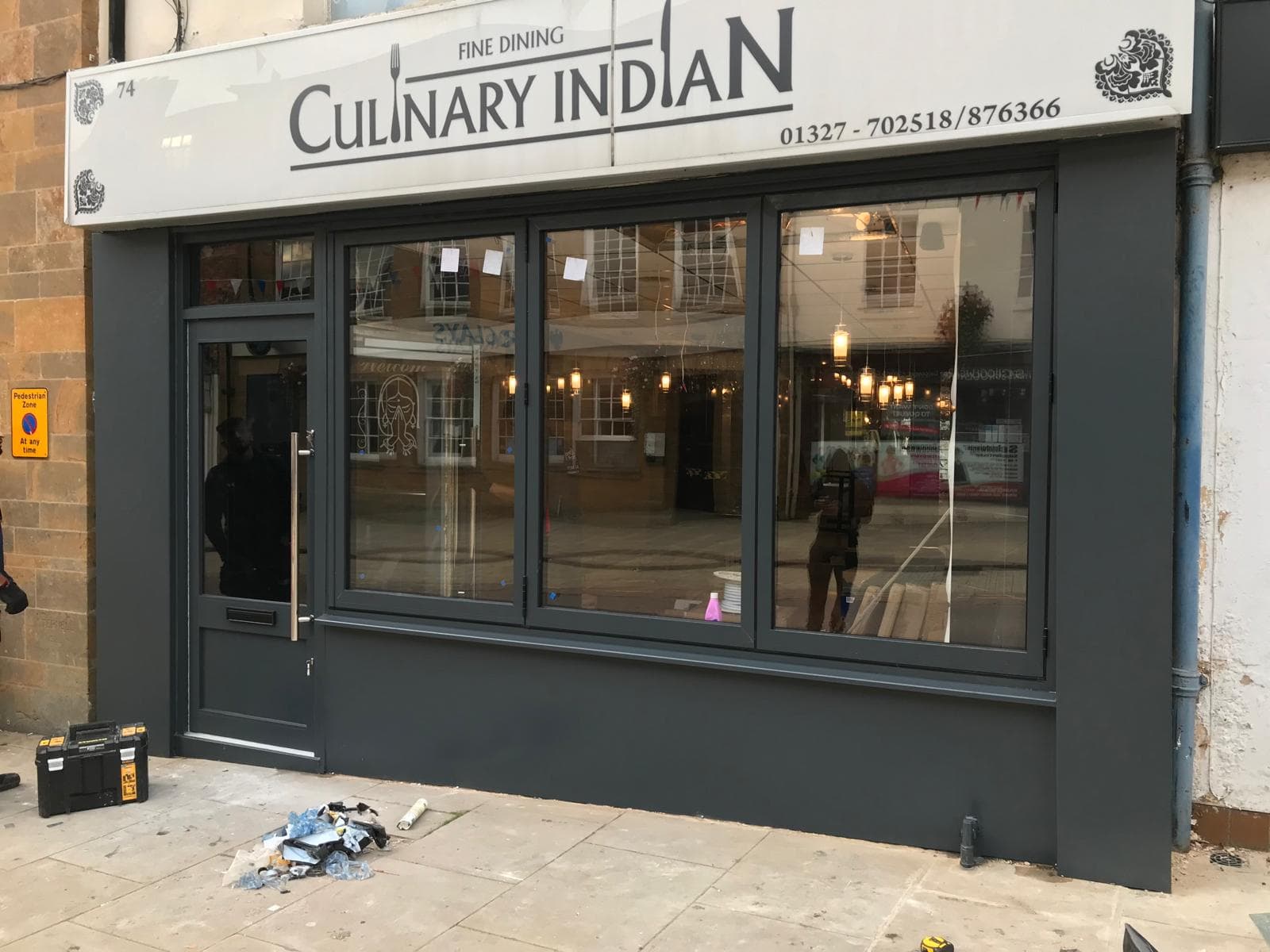
Often, yes — the objection is rarely to the metal itself. What gets a scheme refused is proportion: a single sheet of glass from pavement to fascia, a fascia twice the depth of the original, and the pilasters and stallriser stripped out. An aluminium front that keeps those lines usually reads as a shopfront, not a hole in the building.
On a listed building, or where a council’s guidance asks for timber, ask before you specify. Several of the council documents we track expect historic shopfronts to be repaired rather than replaced at all.
What makes an aluminium front look right on a high street?
Three things: a stallriser of a sensible height, so the glass does not start at the pavement; a fascia sized to the building rather than the brand guidelines; and frame profiles slim enough that the glass, not the metal, is what you see. Glazing bars that line up with the windows above help a frontage sit in a terrace.
Colour does more than people expect. A recessed, dark finish — anthracite, a deep green or a near-black — lets the front sit back into an old façade. Bright white and silver anodised push it forward.
How is security handled without a shutter?
Laminated glass in the frame, a solid stallriser and a properly specified lock do most of the work, and they are what many councils now ask for first. If a shutter is still wanted, plan the box into the fascia at the drawing stage — retrofitting one to a new front is where most bad shopfronts come from.
Standards and regulations
| Reference | What it covers |
|---|---|
| Approved Document K | Safety glazing in critical locations — low-level glass and glass in and beside doors. |
| Approved Document M | Access to and use of the building, including entrance thresholds and door widths. |
| BS EN 12150 / BS EN 14449 | Toughened and laminated safety glass. |
| BS EN 356 | Classes of glass resistance to manual attack, used when laminated glass is doing a security job. |
Indicative prices
- Single bay£2,000 – £5,000Up to about 4 m wide, standard height
- Double bay£4,000 – £8,000Two bays divided by a mullion
- Three bays or more£8,000 – £20,000+Wide and large-format frontages
Supply and fit, before survey. How prices are built up.
Questions
Do I need planning permission to replace a shopfront?
Can you make an aluminium shopfront look traditional?
Related
- Frameless glass fronts — Structural glass with patch fittings, for settings where the view in is the point.
- Aluminium entrance doors — Commercial entrance doors on floor springs or closers, with level thresholds.
- Roller shutters and grilles — Internal, lattice and vision shutters chosen for the street they face, not just the risk.